
Alimentación durante el esfuerzo
Cuando empiezan las náuseas, la alimentación suele detenerse
Nausea is one of the most common reasons endurance athletes stop eating — and once fuelling stops, performance unravels. How to keep the plan alive when the mouth pushes back.

Nausea is one of the most common reasons endurance athletes stop eating.
And once fuelling stops, performance can unravel quickly.
The problem is familiar: after hours of gels, drink mix, chews and sweet flavours, your stomach begins to turn. Your mouth feels coated. The thought of another gel becomes unpleasant. You know you need carbohydrate — but you simply do not want to put anything else in your mouth.
That is exactly the moment UNBTN was designed for.
UNBTN helps reset the mouth, reduce the sensory overload around fuelling, and make it easier to keep eating and drinking when nausea begins to threaten your race.
It does not replace your fuel. It helps you keep using it.
01
Nausea is a performance problem
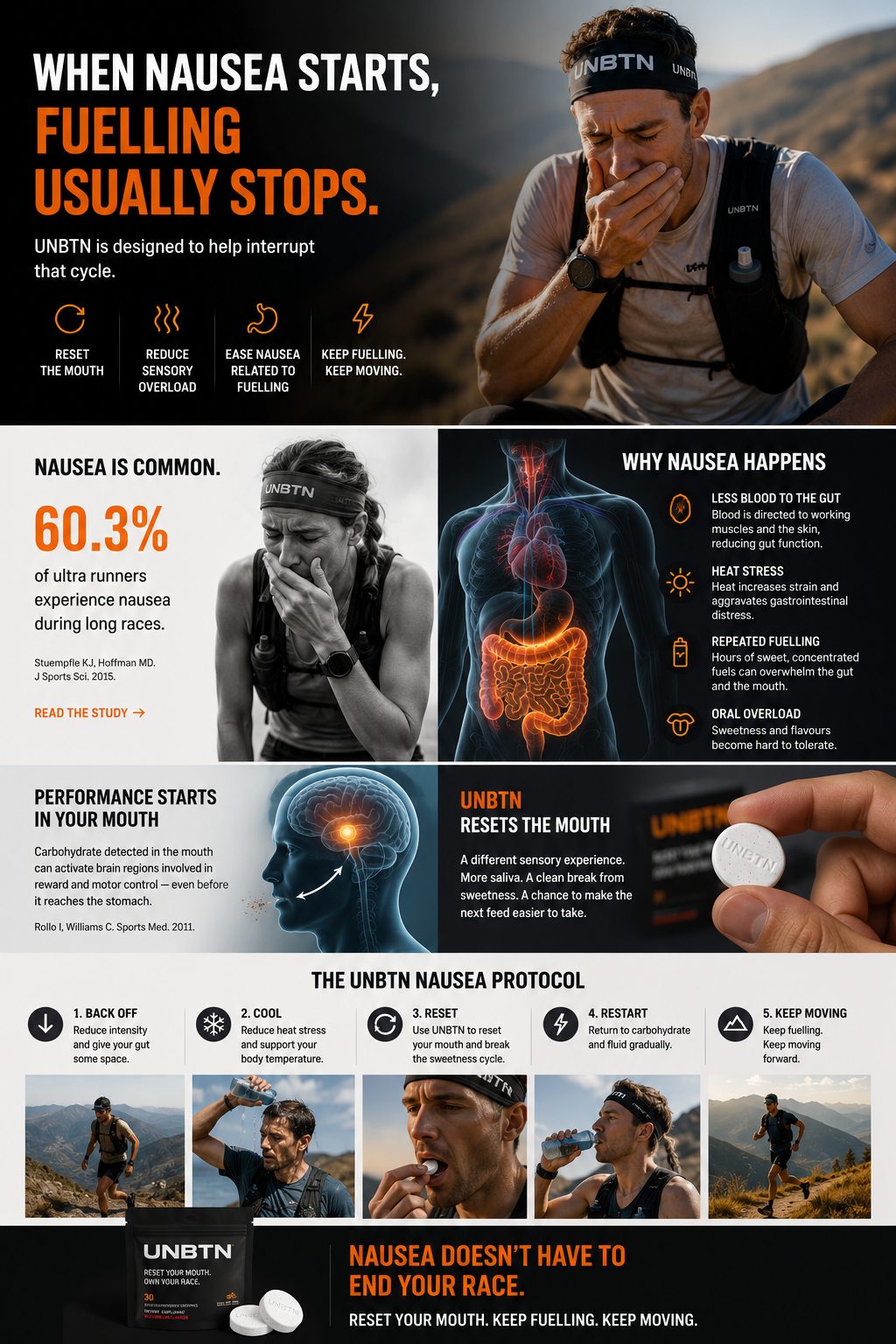
In a study of runners competing in the 161 km Western States Endurance Run, 60.3% experienced nausea.1
Among athletes whose gastrointestinal symptoms affected their performance, nausea was the most commonly reported problem. It was also the dominant GI symptom among runners who failed to finish because of stomach problems.
60.3%
of ultra runners report nausea
161 km
Western States Endurance Run
#1
GI symptom behind DNFs
That matters because endurance racing depends on continuing to take in energy. When nausea makes eating difficult, athletes often reduce carbohydrate intake precisely when their energy demand remains high.
UNBTN is designed to help break that loop.
02
Why endurance athletes become nauseous
Exercise-associated nausea rarely has one single cause. During long and intense exercise, several stresses can accumulate simultaneously.
Less blood reaches the gut
During exercise, blood is redirected toward working muscles. In heat, even more blood is required at the skin to help regulate body temperature. That means less blood can be available to the gastrointestinal system.
Reduced gastrointestinal blood flow — known as splanchnic hypoperfusion — is one of the mechanisms associated with nausea, cramping, abdominal discomfort and other GI symptoms during endurance exercise.2
The longer and harder the race becomes, the more important this can become.
Heat raises the risk
Hot races are particularly challenging. Heat increases cardiovascular strain and places additional stress on gastrointestinal function. Research shows that exertional heat stress can aggravate exercise-induced gastrointestinal disturbances.3
In the Western States study, nausea was most severe during one of the hottest and most demanding sections of the race.
That is why a fuelling plan that works perfectly during a cool training run can suddenly become difficult during a hot mountain race. The athlete has not forgotten how to fuel. Their ability to tolerate fuelling has changed.

03
Then there is the mouth
This part is often overlooked. Endurance fuelling does not begin in the stomach. It begins in the mouth.
For hours, an endurance athlete may repeatedly consume:
- sweet gels
- carbohydrate drinks
- chews
- bars
- electrolyte products
- flavoured foods
Eventually, the sensory load can become enormous. The mouth feels sticky. Sweetness becomes unpleasant. Flavours that were enjoyable at hour one become almost impossible to tolerate at hour eight.
When the mouth rejects the next gel, the stomach never gets the chance to receive it.
04
UNBTN resets the mouth
UNBTN was created as an oral-performance tool between fuelling moments. Instead of adding another gel, another drink or another mouthful of sweetness, UNBTN introduces a different sensory experience.
Allow the lozenge to dissolve slowly. Saliva increases. The mouth changes. The accumulated taste of sports nutrition is interrupted. And the next piece of fuel can become easier to approach.
Reset your mouth. Keep fuelling. Keep moving.
05
Why this may matter for nausea
Nausea during endurance exercise is complex. Some of it comes from the gut. Some comes from heat. Some comes from intensity. And some of the problem is simply that the athlete develops a powerful aversion to eating.
UNBTN is particularly relevant to that last part. When the thought, smell or taste of another sweet product begins triggering a feeling of nausea, changing the oral environment can provide a valuable reset before the next feeding.
06
The mouth talks to the brain
Research on carbohydrate mouth rinsing has demonstrated that carbohydrate detected in the mouth can activate brain regions associated with reward and motor control — even before that carbohydrate reaches the stomach.6
This does not mean that simply tasting something replaces eating carbohydrate during a long race. It does show, however, that the mouth plays a much more important role in endurance performance than simply transporting nutrition to the stomach.
What happens in the mouth influences perception, appetite and the willingness to continue consuming fuel. UNBTN is built around that principle: oral comfort is part of fuelling performance.
07
Make UNBTN part of your nausea strategy
When nausea begins, the instinct is often to stop everything. Stop eating. Stop drinking carbohydrate. Wait for the stomach to recover.
Sometimes a short reduction in intake is sensible. But completely abandoning fuelling can create another problem very quickly. Instead, think in stages.
1. Back off
Reduce the intensity for a few minutes. Walk a steep climb if necessary. Higher exercise intensity is strongly associated with gastrointestinal stress; giving the gut a little more physiological space may help.
2. Cool down
If the conditions are hot, actively manage heat. Use water, shade, ice or whatever cooling strategy is available. Reducing heat stress can reduce one of the physiological drivers behind gastrointestinal distress.
3. Reset the mouth with UNBTN
If sweetness, stickiness or flavour overload is making you feel increasingly nauseous, give your mouth a different stimulus. Let UNBTN dissolve. Allow saliva to build. Clear the taste of the previous gel or drink. Give yourself a few minutes without adding another concentrated carbohydrate product.
4. Restart fuelling
Then return to carbohydrate progressively. A few sips. A smaller portion. A different flavour. A different texture. The objective is to keep the fuelling strategy alive.
08
UNBTN does not replace carbohydrate
This is important. UNBTN is not designed to become your energy source. During prolonged endurance exercise, carbohydrate remains one of the most important nutritional tools available to an athlete.
UNBTN sits between those feeding moments.
Fuel → UNBTN → fuel → UNBTN
Not necessarily on a rigid schedule, but when your mouth needs a break. That makes UNBTN particularly useful later in long races, when repeated fuelling becomes increasingly difficult.
09
You can also train your gut
Race-day nausea should not only be managed on race day. The gastrointestinal system can adapt to repeated carbohydrate intake during training.
In one study, approximately two weeks of repeated carbohydrate feeding during running reduced gastrointestinal symptoms, including nausea.4 Another study found improved GI comfort and running performance following repeated gut training.5
The lesson is simple: train your fuelling like you train your legs.
Practice:
- your race carbohydrate intake
- your drinks and your gels
- hot-weather fuelling
- long-duration fuelling
- using UNBTN between feeds
- recovering when food begins to feel unpleasant
You do not want your first attempt at solving nausea to happen at kilometre 70.
10
The UNBTN nausea protocol
When the stomach begins pushing back:
01
Back off
Temporarily reduce intensity. Walk a steep climb if you need to.
02
Cool
Reduce heat stress wherever possible — water, shade, ice.
03
Reset
Use UNBTN to change the oral environment and break the sweetness cycle.
04
Restart
Return gradually to carbohydrate and fluid.
05
Keep moving
A wave of nausea does not have to end the fuelling plan.
11
Performance starts in your mouth
Endurance nutrition has traditionally focused on what reaches the stomach. We believe that is only part of the picture.
Because before an athlete can digest another gel, they first have to be willing to put it in their mouth. After six, eight or twelve hours of endurance exercise, that can become surprisingly difficult.
UNBTN exists for that moment. When everything tastes too sweet. When your mouth feels overloaded. When another gel starts making you nauseous before you even open it.
Reset. Then fuel again.
12
UNBTN and nausea
UNBTN is not an anti-nausea medicine and does not treat the underlying medical causes of exercise-associated nausea.
But nausea is not only about what happens inside the stomach. For many endurance athletes, the inability to tolerate more flavour, sweetness and repeated sports nutrition becomes part of the problem.
That is where UNBTN can help. It resets the mouth. It gives the athlete a break from repeated sweetness. It supports oral comfort. And most importantly, it can help make continued fuelling feel possible.
Because in an ultra, the objective is rarely to never feel nauseous. The objective is to manage the moment before nausea destroys the fuelling plan.
UNBTN. Reset your mouth. Keep fuelling. Keep moving.
Science behind the article
- 1.Stuempfle KJ, Hoffman MD. Gastrointestinal distress is common during a 161-km ultramarathon. Journal of Sports Sciences. 2015. Nausea occurred in 60.3% of surveyed Western States runners and was a major contributor to performance impairment. PubMed
- 2.de Oliveira EP, Burini RC. Gastrointestinal complaints during exercise: prevalence, etiology, and nutritional recommendations. Sports Medicine. 2014. Overview of mechanisms behind exercise-associated gastrointestinal symptoms, including altered gastrointestinal blood flow and nutritional factors. PubMed
- 3.Costa RJS, et al. Exertional-heat stress-associated gastrointestinal perturbations. 2020. Examines how exercise in heat affects gastrointestinal integrity and symptoms. PubMed
- 4.Miall A, et al. Two weeks of repetitive gut-challenge reduce exercise-associated gastrointestinal symptoms and malabsorption. 2018. Demonstrates that carbohydrate gut training can reduce GI symptoms, including nausea. PubMed
- 5.Costa RJS, et al. Gut-training: the impact of two weeks' repetitive gut-challenge during exercise. 2017. Shows improved gastrointestinal tolerance and running performance after gut training. PubMed
- 6.Rollo I, Williams C. Effect of mouth-rinsing carbohydrate solutions on endurance performance. Sports Medicine. 2011. Reviews evidence that sensing carbohydrate in the mouth can influence brain regions associated with reward and motor activity. PubMed
UNBTN is an oral-performance product and is not intended to diagnose, treat, cure or prevent nausea or any medical condition. Severe or persistent nausea, repeated vomiting, confusion, severe headache or altered mental status during exercise should be assessed by appropriate medical personnel.