
Longévité
S’entraîner longtemps, bien vieillir
The habits that separate 40 years of running from four — consistency, strength, recovery, nutrition, bone health and the mouth that carries every gel.

Running for decades is not simply a matter of staying motivated.
The athletes who continue into their 50s, 60s and beyond usually learn to change the way they train. They stop treating every year as a repeat of the last. They protect strength, recovery, bone health, nutrition and enjoyment — not only weekly mileage.
Aging still changes performance. Maximum aerobic capacity generally declines, recovery can take longer, and muscle strength and power become harder to preserve. But lifelong endurance exercise can meaningfully slow the loss of aerobic capacity and maintain a level of physical function far above that of inactive peers. Masters athletes offer some of the clearest evidence that much of the decline commonly blamed on age is also influenced by reduced activity.1
The goal is not to train as though aging does not exist.
It is to train in a way that makes another decade possible.
The habits that last
Consistency
Small, repeatable weeks beat occasional heroic efforts.
Aerobic base
Protect your engine with mostly easy running and smart intensity.
Strength
Build and maintain strength to support performance and everyday life.
Recovery
Sleep, nutrition and rest days turn training into progress.
Bones & tendons
Progress gradually. Respect the tissues that keep you running.
Oral health
A healthy mouth supports fuelling, training and longevity.
01
Consistency beats heroic weeks
Long-term runners are not the athletes who never miss a session.
They are the athletes who repeatedly return.
A few spectacular training blocks cannot compensate for cycles of excessive loading, injury and long interruptions. Over decades, the most valuable training variable is often the ability to remain sufficiently healthy to continue.
That means:
- increasing load gradually;
- avoiding sudden mileage and intensity spikes;
- adjusting around illness, injury and major life stress;
- accepting easier weeks before the body forces complete rest;
- keeping easy running genuinely easy.
Training should create adaptation without repeatedly exceeding the athlete's capacity to recover.
02
Protect aerobic fitness, but stop chasing every run
Endurance training remains central because aerobic capacity is strongly related to health, independence and endurance performance.
Lifelong endurance athletes generally retain substantially greater aerobic fitness than inactive people of the same age, although even highly trained athletes experience some age-related decline. Part of that decline reflects changes in maximum heart rate, stroke volume, muscle characteristics and training volume.3
The answer is not to make every run harder. A sustainable week usually contains:
- mostly low-intensity aerobic running;
- a limited amount of quality work;
- occasional faster running to preserve speed and economy;
- recovery that matches the load.
Intensity is useful. Constant intensity is expensive.
Older athletes may still complete intervals, hills and races successfully, but they often need more deliberate spacing between demanding sessions.2
03
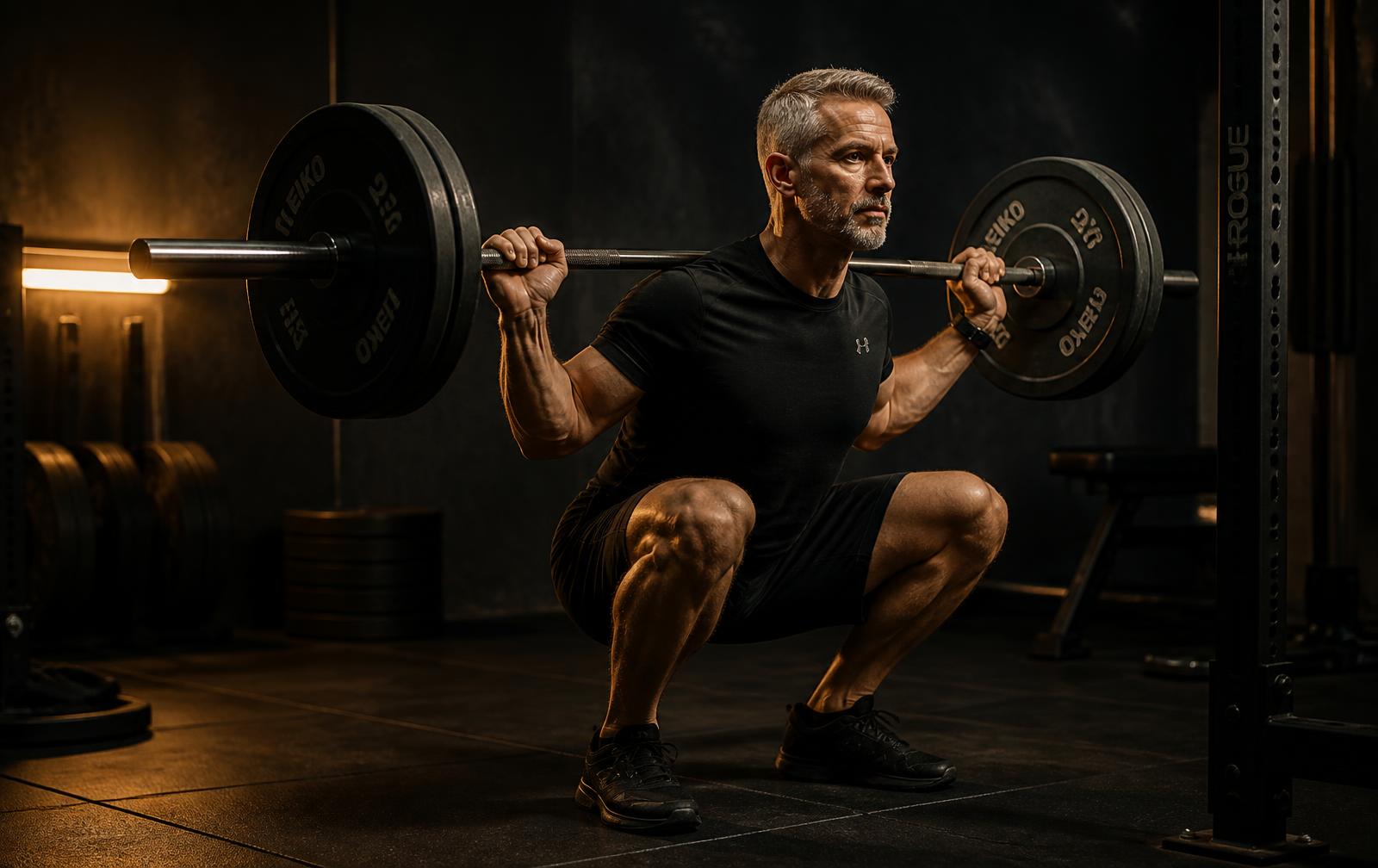
Strength becomes increasingly important
Running preserves endurance well, but it does not completely protect muscle strength, fast-twitch fibres or rapid force production.
Research comparing lifelong endurance and strength-trained older athletes suggests that endurance training is especially effective at preserving aerobic characteristics, while strength training provides stronger protection for maximal strength, fast-twitch muscle and rapid force capacity.4
For a lifelong runner, strength supports more than performance. It helps preserve:
- force production;
- uphill and downhill control;
- balance;
- running economy;
- muscle mass;
- bone-loading capacity;
- everyday physical independence.
A practical programme may include one or two sessions each week built around:
- squats or split squats;
- hinges or deadlift variations;
- calf and soleus work;
- step-ups;
- pulling and pushing movements;
- trunk stability;
- controlled jumping or plyometrics when appropriate.
Heavy and combined strength methods can improve endurance-running performance, although the ideal programme depends on training history, injury status and technical experience.4
04
Preserve speed before it disappears
Many runners respond to age by doing more slow mileage and removing fast running entirely.
That may feel safe, but it can accelerate the loss of qualities that are already vulnerable with age: neuromuscular speed, stiffness, coordination and rapid force production.
Short hill sprints, strides and carefully controlled intervals can help maintain those qualities without requiring large volumes of exhausting work. The dose can remain small:
- four to eight relaxed strides;
- brief hill repetitions with full recovery;
- short controlled intervals;
- occasional faster finishes when fresh.
Fast running should leave the athlete stimulated — not dismantled.
05
Treat recovery as training
The ability to absorb training matters more than the ability to survive it.
With advancing age, some athletes notice that muscular soreness, tendon irritation and fatigue remain longer after demanding sessions. That does not mean older athletes should stop training hard. It means recovery must become part of programme design rather than an afterthought.
Useful habits include:
- keeping hard days clearly separated;
- sleeping enough;
- eating soon after demanding or prolonged sessions;
- avoiding repeated training with low energy availability;
- reducing load when soreness changes movement;
- taking easy days before fatigue becomes injury.
06
Eat to maintain, not merely to stay light
Aging runners often carry an old endurance belief: lighter is always better.
But long-term performance depends on retaining muscle, bone and the ability to recover. Older adults may experience a reduced muscle-protein-building response to food and exercise, often described as anabolic resistance. Even lifelong athletes may not be fully protected.5
Adequate total energy and protein therefore become increasingly important. Protein should be distributed across the day rather than saved for one large evening meal. Carbohydrate should support the work being performed, especially around long and intense sessions. Calcium, vitamin D and overall dietary quality also matter for bone health.
Energy restriction may produce a lower body mass while quietly reducing:
- recovery;
- muscle;
- bone resilience;
- hormone function;
- training consistency.
The best racing weight is not the lowest weight an athlete can reach. It is the weight at which they can repeatedly train, recover and remain healthy.
07
Respect bones and tendons
Cardiovascular fitness can improve faster than connective tissues adapt.
This mismatch matters when athletes return after a break, increase mountain volume or suddenly add speed. The heart and lungs may feel ready before the bones, tendons and muscles are prepared for the new load.
Bone-stress-injury prevention requires more than calcium. Important factors include gradual load progression, rest, resistance training and sufficient nutrition.6
Persistent, localised pain that worsens with impact should not be treated as routine stiffness.
08
Keep oral health inside the performance plan
Decades of endurance training also mean decades of repeated exposure to carbohydrate products, acidic drinks, mouth breathing and periods of reduced saliva.
Oral-health problems are common in athlete populations. Reviews report substantial levels of dental caries, erosion and gum disease, although estimates differ widely between sports and studies.7
This matters beyond appearance. Dental pain, inflammation and treatment can interrupt sleep, nutrition, training and competition. Poor oral health has also been associated with athletes reporting reduced training or performance, although association does not prove that oral disease directly caused the performance decline.8
Long-term athletes should therefore treat oral care with the same seriousness as footwear or recovery:
- attend regular dental checks;
- use fluoride toothpaste unless advised otherwise;
- take concentrated fuel with water when appropriate;
- avoid holding acidic drinks around the teeth;
- rinse with water after prolonged fuelling;
- investigate persistent dry mouth or sensitivity.
Healthy aging includes keeping the mouth functional enough to eat, fuel and train comfortably.
09
Keep adapting the athlete identity
The runner at 60 should not be a failed copy of the runner at 30.
A long athletic life requires allowing goals to evolve. At different times, success might mean:
- a personal best;
- completing a mountain ultra;
- returning after injury;
- retaining weekly consistency;
- racing a new distance;
- running pain-free;
- helping another athlete;
- continuing to move confidently.
Athletes who remain emotionally attached only to past pace may interpret every change as failure. Athletes who remain curious can continue improving something — even when absolute speed declines.
10
Where UNBTN fits
UNBTN cannot prevent aging, preserve muscle or replace sensible training.
It supports one small but recurring part of the endurance process: the mouth through which years of hydration and fuel must pass.
During long exercise, mouth breathing, fluid loss and repeated use of gels or sports drinks can leave the mouth dry, sticky and overloaded by sweetness. Reduced oral comfort may make athletes reluctant to continue consuming the carbohydrate and fluid they still need.
UNBTN Oral Performance is a sugar-free lozenge designed to stimulate natural saliva and support oral comfort between fuelling moments. It may help by:
- relieving dry-mouth sensations;
- supporting natural oral lubrication;
- providing a sensory reset between sweet products;
- helping clear concentrated fuel residue from the mouth;
- making the fuelling routine feel more manageable.
UNBTN uses HAp⁺, a calcium-balanced formulation developed to stimulate saliva while remaining non-erosive under its validated testing conditions.
That may seem like a small contribution. But lifelong running is built from small habits repeated thousands of times.

11
The 40-year mindset
Athletes who run for four decades rarely do everything perfectly.
They simply learn what must remain consistent — and what must change.
- They keep the aerobic habit.
- They maintain strength.
- They fuel enough.
- They protect bones, tendons and teeth.
- They recover before exhaustion becomes interruption.
- They revise their goals without abandoning their identity.
And they continue finding reasons to begin again.
Train for the race in front of you. Build habits for the runner you still want to be decades from now.
Selected references
- 1.Valenzuela PL, et al. Lifelong endurance exercise as a countermeasure against age-related decline: physiological overview and insights from masters athletes. Sports Medicine. 2020. PubMed
- 2.Gries KJ, et al. The aging athlete: paradigm of healthy aging. International Journal of Sports Medicine. 2022. PubMed
- 3.Tanaka H, Seals DR. Endurance exercise performance in Masters athletes: age-associated changes and underlying physiological mechanisms. Journal of Physiology. 2008. PubMed
- 4.Tøien T, et al. The impact of lifelong strength versus endurance training on muscle morphology and function in older adults. 2023. PubMed
- 5.Pérez-Castillo ÍM, et al. Age-related anabolic resistance: nutritional and exercise considerations in masters athletes. 2025. PubMed
- 6.Knobloch AC, et al. Bone stress injuries in endurance athletes. 2025. PubMed
- 7.Schulze A, et al. Sports diet and oral health in athletes: a comprehensive review. Nutrients. 2024. PubMed Central
- 8.Zamudio FC, et al. Prevalence and severity of oral conditions in elite athletes: a systematic review and meta-analysis. 2025. PubMed